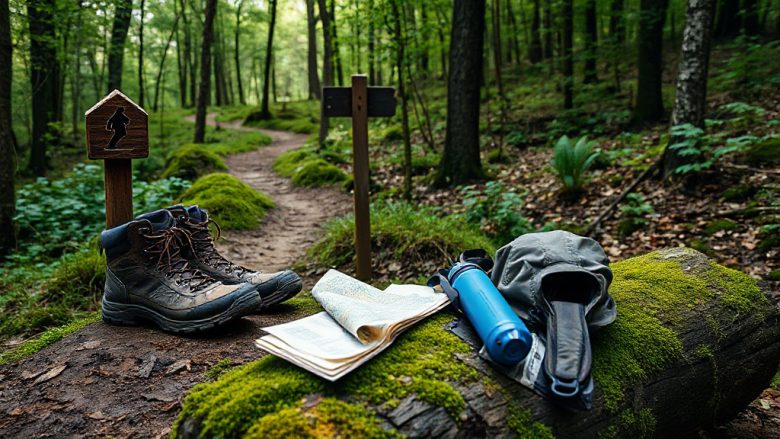
You set off on a trail you’ve been looking forward to all week. The path winds through old woodland, the light is doing that golden thing through the leaves, and for the first two miles everything feels perfect. Then the blisters start. Or the sky turns an ugly grey. Or you realise the fork you took twenty minutes ago was the wrong one and the map is still folded in the car. Most ruined walks don’t fall apart because of bad luck. They fall apart because of a handful of small, repeatable mistakes that almost every casual walker makes at some point. The good news is that all of them are easy to fix. Here are the most common nature walks mistakes to avoid, with a practical correction for each one, so your next outing stays the pleasant escape it was meant to be.
1. Wearing the Wrong Footwear on Uneven Ground
This is the mistake that ends more walks early than any other. Trainers that feel fine on pavement turn into a problem the moment you hit mud, loose gravel or a root-covered descent. The soles are too soft, the grip is too shallow, and the ankle has no support when the ground shifts under you.
The fix isn’t to buy the most expensive boots in the shop. It’s to match the shoe to the surface. For a flat towpath or an easy meadow loop, a decent pair of walking shoes with a grippy sole is plenty. For anything with real ups and downs, tree roots, or the chance of wet ground, you want a boot or shoe with a stiffer sole and a tread you can see clearly. Test the grip by pressing your thumb into the sole — if it barely dents, it’ll hold on a slope.
Two smaller footwear habits matter just as much. First, break new boots in on short local walks before trusting them on a long one. Second, deal with socks properly. Cotton socks hold sweat against the skin and are the quiet cause of most blisters. A thin liner sock under a wool or synthetic walking sock makes a surprising difference, and it costs very little.
If you already feel a hot spot forming, stop and deal with it there and then. A plaster applied early saves the rest of the day. Ignoring it for another mile is how a small rub becomes a walk-ending blister.
2. Ignoring the Weather Forecast and the Sky Above You
Weather is the mistake people feel most foolish about afterwards, because the information was available the whole time. A morning that starts clear can turn into a cold, wet afternoon faster than most walkers expect, especially on higher ground or near the coast where conditions shift quickly.
Check the forecast the night before and again on the morning of the walk. Look at the wind speed, not just the temperature, and look at the chance of rain across the hours you’ll actually be out, not just at the start. If you’re heading somewhere exposed, add a windproof layer even when the forecast looks kind.
The correction is a small, permanent habit: carry a lightweight waterproof jacket and a spare warm layer in your bag on every walk, whatever the sky is doing when you leave. They weigh almost nothing and they turn a miserable soaking into a minor inconvenience. A simple hat and gloves in winter cost little space either.
Learn to read the sky as a backup. If clouds are building vertically and turning dark at the base, rain or a storm isn’t far off. If the wind picks up suddenly and the temperature drops, change is coming. Turning back early is not a failure. It’s good judgement, and the trail will still be there next week.
3. Setting Off Without a Map or a Plan
Plenty of walkers rely on memory, a rough sense of direction, or the assumption that a marked path will stay obvious. It usually does, until it doesn’t. A junction with no sign, a path that fades into a field, a fallen tree hiding the way on — any of these can turn a relaxed stroll into an hour of wandering.
Before you leave, know the route. That can be a paper map, an offline map saved on your phone, or a clear written description of the turns. The key word is offline. Phone signal disappears in valleys, dense woodland and remote areas, and a map that needs a connection is no map at all when you need it most.
Tell someone where you’re going and when you expect to be back. It takes thirty seconds and it’s the single most useful safety habit a walker can have. If something goes wrong, someone knows where to start looking.
On the walk itself, pay attention at junctions. Pause, check the map, and confirm which way you’re turning before you commit. Most wrong turns happen because someone kept walking while half-thinking about something else. A ten-second check at each fork prevents almost all of them.
It also helps to note landmarks as you go — a distinctive gate, a bridge, a lone tree. On the way back, or if you need to retrace your steps, those markers make the route far easier to follow than a line on a screen.
4. Disturbing Wildlife, Livestock and the Landscape
Nature walks are about being among wildlife, not chasing it. The most common version of this mistake is getting too close for a photo, following an animal to get a better view, or letting a dog run loose through a field of sheep or a nesting area. It stresses the animals, and in the case of livestock it can put you in real danger.
The correction is simple and worth repeating: observe from a distance, use a zoom or binoculars rather than your feet, and keep dogs under close control or on a lead wherever livestock or ground-nesting birds might be present. If a farm animal approaches, give it space and move away calmly rather than trying to shoo it.
The same respect applies to the ground under your boots. Stick to the path where one exists, especially on fragile ground like moorland, dunes or muddy trail edges. Cutting corners across a field or a flower-rich verge causes damage that can take years to recover. Take your litter home, including fruit peel and crumbs, which don’t belong in the countryside even though they rot.
Leave gates as you find them. If a gate is closed, close it behind you. If it’s open, leave it open. Farmers rely on this, and getting it wrong can let animals onto roads or into the wrong field.
5. Pacing the Walk Badly and Underestimating the Route
New walkers often plan by distance alone and forget about time, terrain and climbing. A five-mile flat path is a very different outing from five miles of steep up-and-down. Add a few stiles, a muddy section and a couple of photo stops, and a route that looked like two hours becomes four.
Be honest about your pace. A relaxed walking pace on mixed ground is often around two miles an hour, sometimes less on hills. Plan the day around that figure, add time for stops, and aim to finish well before dark. Starting late is one of the quiet causes of rushed, unpleasant walks and, occasionally, of having to walk the last stretch in failing light.
Pace the walk itself, too. Setting off at a sprint because you’re excited is a fast route to tired legs and a miserable second half. Start slower than feels natural, warm into it, and keep something in reserve for the final section. Take short breaks before you’re desperate for them, not after.
Carry more water than you think you need, and a bit of food. Hunger and dehydration both make people clumsy, irritable and bad at decisions, which is exactly when mistakes happen. A handful of nuts or a sandwich halfway round keeps the whole day on track.
6. Overpacking, Underpacking and Forgetting the Essentials
There’s a sweet spot between carrying half your house and carrying nothing useful at all, and most walkers miss it in one direction or the other. The overpacker arrives exhausted from a heavy bag. The underpacker arrives without a torch, a plaster or a waterproof and regrets it.
Build a small, fixed kit that lives in your bag so you never have to think about it. A basic version covers water, a snack, a waterproof layer, a warm layer, a charged phone, a small first-aid pouch with plasters and blister patches, a torch or head torch, and a map or offline route. In summer, add sun cream and a hat. In winter, add gloves and an extra layer.
Check the bag before you leave. It’s easy to assume the torch is in there from last time, only to discover it isn’t when the light starts going. A thirty-second check at the door saves a lot of trouble later.
Charge your phone before you go, and consider carrying a small power bank on longer walks. Your phone is your camera, your map and your emergency contact all at once, and a dead battery removes all three.
7. Treating the Walk as a Race and Missing the Point
This is the least obvious mistake, but it spoils more walks than any blister. Rushing to tick off miles, headphones in the whole way, eyes on the path rather than the world around it — that’s a workout, not a nature walk. The whole reason to be out there is the thing you’re walking past.
Slow down. Stop when something catches your eye. Listen for a minute without talking. Notice what’s flowering, what’s calling, what the light is doing. These small pauses are what people remember about a walk, not the pace they held.
It also pays to build in flexibility. If a side path looks interesting, take it if time allows. If the weather turns, adjust rather than pushing on grimly. If you’re tired, turn back. A walk is meant to leave you feeling better than when you started, and that’s the real measure of whether it went well.
Finally, respect the fact that not every walk needs to be an achievement. A short loop around a local wood, done slowly and with attention, beats a long, rushed route you barely noticed. The best habit any walker can build is simply to go out often, go prepared, and let the day unfold at walking pace. Get those basics right and most of the common nature walks mistakes to avoid simply stop happening — which leaves you free to enjoy the trail for exactly what it is.