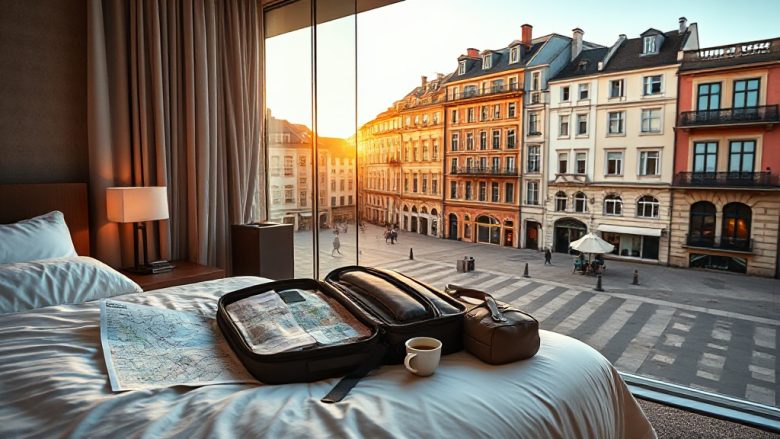
Friday night, you land. The airport train rattles into the city, you dump your bag at the hotel and head straight out for dinner, already calculating how few hours are left until Sunday. By the time you’re on the way home, you’re shattered, your feet ache, and you can barely remember what you actually did beyond queuing for things and eating two rushed meals. The weekend happened to you rather than the other way around.
If that sounds familiar, the answer isn’t to cram in less. It’s to plan the right things in the right order. Learning how to improve your weekend city breaks is mostly about removing friction, not adding more sights. Here’s how to diagnose what’s going wrong and fix it, one problem at a time.
The schedule is too full, so nothing lands
The classic mistake is treating a 48-hour trip like a checklist. You book three museums, a cathedral, a food market, a rooftop bar and a day trip to a nearby town, then spend the whole weekend watching the clock. Every stop becomes a photo opportunity rather than something you actually experience. You leave with a camera roll and a vague sense of having been somewhere.
The fix is to pick one anchor per day, then let everything else orbit around it. An anchor is the single thing you’d be genuinely sorry to miss: a specific gallery, a particular neighbourhood walk, a meal you’ve been looking forward to. Everything else is optional. If you get to it, great. If you don’t, you’ve still had a good day.
Two anchors across a weekend is plenty. That leaves space for the things that actually make a trip memorable, which are usually unplanned: a coffee that turns into two hours in a square, a market you stumble into, a conversation with someone who points you somewhere you’d never have found. A schedule with gaps isn’t lazy. It’s what gives the weekend room to breathe.
Try this on your next trip: write down your must-do list, then cross off everything except the top two. You’ll be surprised how much better the weekend feels.
You picked the wrong neighbourhood to stay in
Hotel choice is usually made on price and star rating, and almost never on location in the way that actually matters. A cheap room near the airport, or in a business district that empties out at 6pm, will cost you an hour each way into the parts of the city you actually came to see. You save forty pounds on the room and spend it on taxis and lost time.
The better approach is to stay where you want to spend your evenings, not where you want to spend your days. Days are for moving around. Evenings are for the short walk back to the hotel after dinner, when you’re tired and the city is at its most atmospheric. Being ten minutes from a good cluster of restaurants and bars is worth far more than a slightly nicer room in a dead quarter.
Before booking, look at the area on a map and ask two questions. Is there a cluster of places to eat within a short walk? And is there a direct transit link to the main sights, or does it require two changes? If the answer to either is no, keep looking. A slightly smaller room in the right spot beats a spacious one in the wrong one every time.
One more thing: check what the neighbourhood is like on a Sunday. Some districts that are lively on a Friday are shuttered by Sunday afternoon, which is exactly when you’ll want somewhere to sit and eat before heading home.
You’re not counting transit time realistically
This is the quiet killer of weekend trips. You look at a map, see that the museum is only three stops away, and assume it’s a ten-minute hop. In reality it’s a walk to the station, a wait, the journey, a walk at the other end, and a wrong turn. Twenty-five minutes, minimum, and that’s before you factor in getting lost or a line closure.
Every journey in a new city takes longer than it looks. Double your estimate. If you think a cross-town trip is twenty minutes, budget forty. That sounds pessimistic until you realise it’s the reason your carefully planned afternoon keeps falling apart.
The fix isn’t just padding the times. It’s grouping. Cluster your stops by area so you’re not criss-crossing the city. Do the old town in the morning and the riverside in the afternoon, and you’ll spend your time walking between interesting things rather than sitting on transport. A good weekend itinerary looks less like a route and more like a few tight loops.
Also, walk more than you think you should. In most European cities, the distance between two central neighbourhoods is often only twenty minutes on foot, and the walk is the experience. You notice the architecture, the small shops, the places that don’t make it onto any list. Transit gets you there. Walking shows you where you are.
You keep eating in the wrong places
Tourist-trap restaurants are rarely a deliberate choice. They’re what happens when you’re hungry, it’s 8pm, and the first place with a menu in English is right in front of you. The food is fine, the bill is high, and you’ve spent one of your few meals on something forgettable.
The fix starts before you get hungry. Decide where you’re eating before you leave the hotel, or at least before you’re ravenous. Hunger makes you accept the first option, and the first option in a busy tourist area is almost always the worst value in the city.
A simple rule: walk two streets back from the main square or the landmark. Prices drop, quality rises, and the menu is more likely to be in the local language. If the menu is translated into six languages and there’s a photo of every dish, keep walking. If it’s handwritten and you can’t read half of it, you’re in the right place.
Lunch is your secret weapon. In most cities, the same restaurant that charges a fortune at dinner serves a set lunch at a fraction of the price. Book your one big dinner for the evening you arrive, when you’re still fresh and excited, and use lunches for the rest of the weekend. You’ll eat better and spend less.
And don’t over-plan the food. One memorable meal beats three average ones. Leave the rest to chance and let a market stall or a bakery counter surprise you.
You’re treating the journey home as an afterthought
The last day is where good weekends go to die. You check out at eleven, drag your bag around for six hours, and end up at the airport three hours early, exhausted and resentful. The trip ends on a low note, and that’s the feeling you remember.
Plan the final day backwards from your departure. Work out exactly when you need to leave the city centre, then build a short, low-effort morning before it. A slow breakfast, one small stop nearby, and a relaxed route to the station. Nothing ambitious. The last day is for winding down, not squeezing in one more museum.
If your hotel will store your bag after checkout, use it. A day spent without luggage is a completely different experience. If not, station lockers are usually cheap and worth every penny. Wandering a city with a rucksack on your back makes you want to leave. Wandering it hands-free makes you want to stay.
And build in a buffer. Trains and flights go wrong. A two-hour cushion before your departure turns a potential disaster into a minor inconvenience. You’ll never regret having spare time at the end of a trip, but you’ll always regret not having it.
Try this on your next trip
Before you go, do five things. Pick two anchors for the weekend and treat everything else as optional. Book a hotel in a neighbourhood you’d actually want to spend an evening in. Double every transit time in your head and group your stops by area. Decide where you’re eating before you’re hungry, and walk two streets back from the obvious spots. Plan the final day backwards from your departure, and store your bag so you’re not carrying it.
That’s it. None of it involves doing more. It’s about doing the right things in the right order, leaving room for the accidental moments that make a city feel like somewhere you’ve been rather than somewhere you’ve ticked off. Get those five things right and your weekend will feel twice as long, cost about the same, and leave you wanting to go back rather than needing a holiday to recover.